






ORGANS OF PARIS © 2026 Vincent Hildebrandt HOME ALL ORGANS


Clavi-organum, builder unknown
A curious instrument born from the unnatural
coupling of a bourdon and a lute on the second
keyboard of a small organ whose first keyboard also
sounded the bourdon alone. This instrument then
combines a harpsichord by the presence of a lute
(stringed) playable on the second keyboard and a
positive organ by the presence of an 8' Bourdon
common to the two manual keyboards. Pédalier en
tirasses.
E6
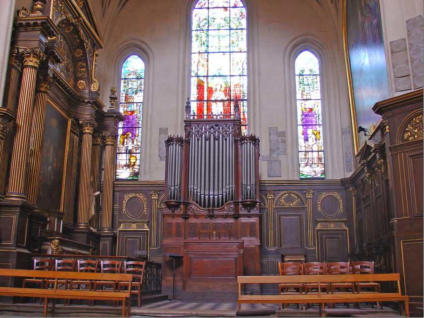
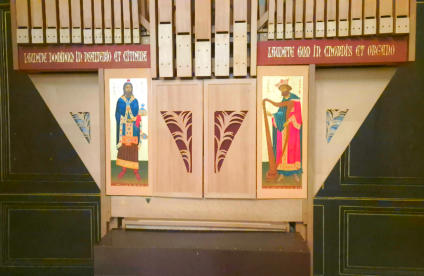
The south transept organ of St Gervais was built by the
Maison Daublaine-Callinet in 1845 and inaugurated by
Boëly and Fessy. It had 13 stops. The pedal bass was
borrowed from the 16' Bourdon of the Grand Orgue. The
neo-Gothic case was designed by Baltard.
It was overhauled in 1912 (Reinburg) and 1930
(Rochesson).
In 1940, it was moved to the front of the south transept.
In 1957, Rochesson added a first octave (12 notes) to the
8' Bourdon of the Récit.
In 1967, during another overhaul, Gutschenritter added a
Doublette and a Plein-Jeu III/IV ranks on the Grand Orgue,
on a pneumatic chest. The instrument was moved to the
back of the south transept arm.
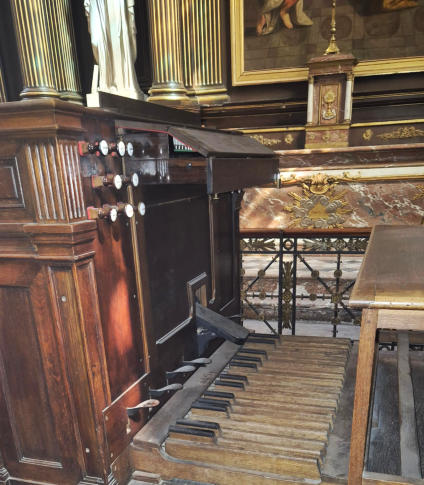
In 1992, it was restored by Bernard Dargassies. Over the
years, successive interventions had left the Récit with a
Gambe and a Céleste made up of mismatched pipes. The
Cornet had been placed on the Grand Orgue. The
windchests were split. During the 1992 work, Dargassies
had the opportunity to rebuild and reorganize them, in
order to remove the layers of later alterations, which had
resulted in no real coherence. The added stops were
reworked and integrated into the rebuilt windchest. He
also rebuilt the Récit and restored the original tonal
material to order. Finally, at his own expense, he made an
almost complete copy of the console, so damaged had its
framework and even its case become through the
successive interventions, while still preserving the spirit
of the original craftsmanship.
XIXth - Buffet
1845 - Daubaine-Callinet (1)
1912 - Charles Reinburg (6)
1930 - Louis-Eugène Rochesson (6)
1957 - Louis-Eugène Rochesson (6)
1967 - Joseph Gutschenritter (3b)
1992 - Bernard Dargassies (3a)
II/16 (15) - mechanical traction
Stoplist
Orgue du transept nord
GO>










The organs of Paris


ORGANS OF PARIS © 2026 Vincent Hildebrandt

XIXth - Buffet
1845 - Daubaine-Callinet (1)
1912 - Charles Reinburg (6)
1930 - Louis-Eugène Rochesson (6)
1957 - Louis-Eugène Rochesson (6)
1967 - Joseph Gutschenritter (3b)
1992 - Bernard Dargassies (3a)
II/16 (15) - mechanical traction
Stoplist
E6
The south transept organ of St Gervais was built by the
Maison Daublaine-Callinet in 1845 and inaugurated by Boëly
and Fessy. It had 13 stops. The pedal bass was borrowed
from the 16' Bourdon of the Grand Orgue. The neo-Gothic
case was designed by Baltard.
It was overhauled in 1912 (Reinburg) and 1930 (Rochesson).
In 1940, it was moved to the front of the south transept. In
1957, Rochesson added a first octave (12 notes) to the 8'
Bourdon of the Récit.
In 1967, during another overhaul, Gutschenritter added a
Doublette and a Plein-Jeu III/IV ranks on the Grand Orgue, on
a pneumatic chest. The instrument was moved to the back of
the south transept arm.
In 1992, it was restored by Bernard Dargassies. Over the
years, successive interventions had left the Récit with a
Gambe and a Céleste made up of mismatched pipes. The
Cornet had been placed on the Grand Orgue. The windchests
were split. During the 1992 work, Dargassies had the
opportunity to rebuild and reorganize them, in order to
remove the layers of later alterations, which had resulted in
no real coherence. The added stops were reworked and
integrated into the rebuilt windchest. He also rebuilt the
Récit and restored the original tonal material to order.
Finally, at his own expense, he made an almost complete
copy of the console, so damaged had its framework and even
its case become through the successive interventions, while
still preserving the spirit of the original craftsmanship.

Clavi-organum, builder unknown
A curious instrument born from the unnatural coupling of a
bourdon and a lute on the second keyboard of a small organ
whose first keyboard also sounded the bourdon alone. This
instrument then combines a harpsichord by the presence of
a lute (stringed) playable on the second keyboard and a
positive organ by the presence of an 8' Bourdon common to
the two manual keyboards. Pédalier en tirasses.
Orgue du transept nord
GO>


